Plan Better, Waste Less and Stop Losing Margin to a Factory Floor That Runs on Instinct: Practical AI tools Northern Ireland manufacturers, production planners and operations managers can put to work right now
Most Northern Ireland manufacturers are not short of data. They are short of a way to use it. The production schedule lives in a spreadsheet, the maintenance log in a folder nobody opens, and the real reason last Tuesday went wrong is locked inside someone's head. That does not have to be the way it works.
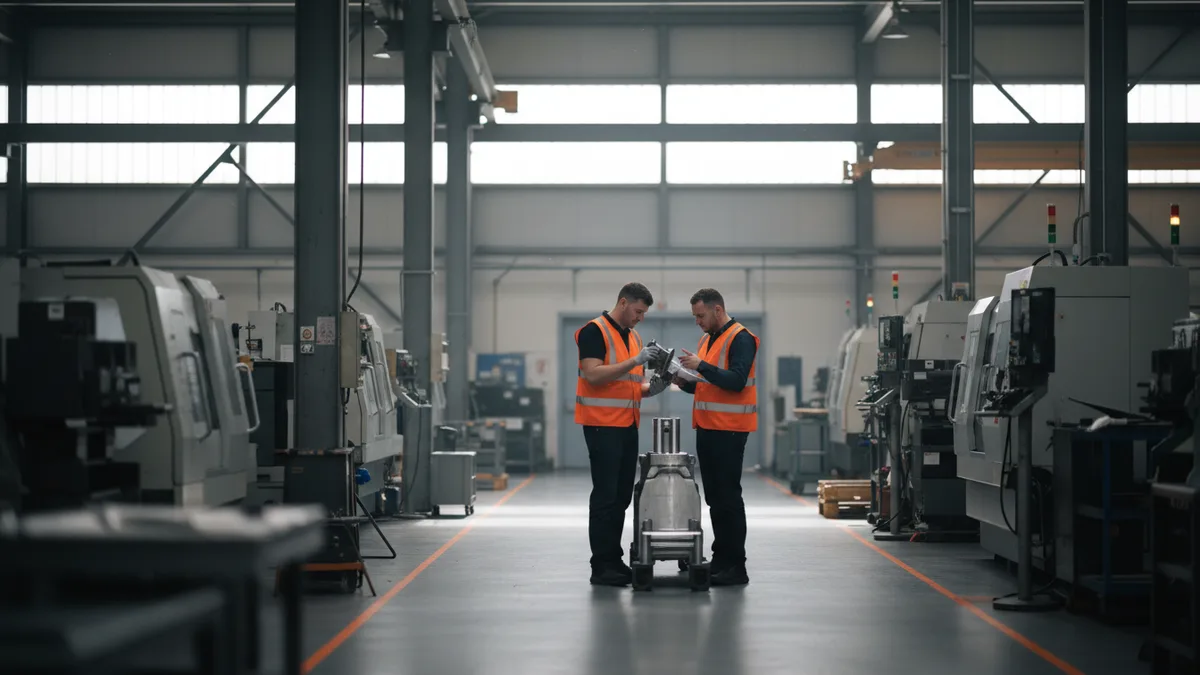
There is a particular kind of frustration that manufacturing managers in Northern Ireland know well. You finish a shift that should have hit target, and it did not, and you spend the next hour trying to piece together why. Was it the changeover that ran long? The batch that came back from QC? The supplier who delivered short and nobody flagged it until the line stopped? The information exists somewhere. It is in the ERP, the spreadsheet the planner keeps, the email the warehouse sent at half seven in the morning. But pulling it together takes time you do not have, so you make a call on experience and move on.
That works, up to a point. The problem is that every one of those judgment calls that goes slightly wrong costs money. A line that sits idle for forty minutes while someone chases a part. A production run that gets scheduled too tight and needs overtime to finish. A quality issue that gets caught at the end rather than the middle. None of these are catastrophic on their own, but across a week, a month, a quarter, they add up to margin that quietly disappears. Private AI, connected to the systems and data a factory already has, is increasingly good at catching exactly these things before they become a problem.
Why Northern Ireland manufacturers are well placed to benefit
Northern Ireland has a broad and resilient manufacturing base. From precision engineering firms in Newry and Antrim to plastics processors in Ballymena, packaging operations in Londonderry and component suppliers dotted across the mid-Ulster corridor, the sector employs tens of thousands of people and contributes a meaningful share of the region's output. Many of these businesses have invested steadily in equipment and systems over the years. They often have an ERP or MRP system, a quality management process, maintenance records, supplier data and production history going back years.
What they frequently do not have is a way to connect all of that information and ask it useful questions in real time. The ERP talks to the accounts team. The production schedule lives separately. The maintenance log is either in the system or in a paper folder depending on the site. A private AI platform can sit across all of that, pull it together and start surfacing the patterns that experienced managers have been spotting by instinct for years, only faster and more consistently.
This matters particularly for Northern Ireland businesses because many of them are supplying into demanding customer relationships, whether that is a major retailer, a Tier 1 automotive customer or an agri-food processor with tight specifications. Missed deliveries, quality escapes and planning failures have consequences that go beyond a single order. Anything that makes planning more reliable and quality more consistent is worth taking seriously.
Production planning that learns from what actually happened
Most production planning in smaller manufacturing businesses is done by one or two experienced people working from a combination of system data, spreadsheets and knowledge they carry in their heads. That is not a criticism. It works. But it has limits.
A planner who has been doing the job for fifteen years knows that a particular product family always runs slower on a Monday morning after a weekend shutdown, or that a specific machine needs an extra thirty minutes of warm-up time in winter. That knowledge is valuable. The problem is that it does not transfer easily, it is hard to apply consistently across a complex schedule and it can be wrong in ways that only become visible after the fact.
An AI system connected to your production history, your machine data and your order book can build a model of how your factory actually behaves, not how it is supposed to behave on paper. It can flag that the current schedule has a constraint building up on Wednesday afternoon before anyone has noticed. It can suggest that a particular job should be brought forward because the materials are available now and a gap is opening up. It does not replace the planner. It gives the planner better information, faster.
Maintenance and downtime: the cost that hides in plain sight
Unplanned downtime is one of the most expensive things that can happen on a production floor, and it is also one of the most predictable, if you are looking at the right data. Most manufacturing businesses collect a significant amount of machine and maintenance data. Much of it sits in a CMMS or a spreadsheet and gets reviewed after something breaks rather than before.
A private AI system can monitor that data continuously and flag when a pattern is developing that has historically preceded a failure. This is not magic. It is pattern recognition applied to data you already have. If a particular motor has shown elevated current draw in the three days before it has failed twice in the past two years, that is a signal worth catching. If a machine tends to produce out-of-tolerance parts after a certain number of hours without a specific calibration check, that is worth knowing before the batch goes to QC.
The key point for smaller manufacturers is that you do not need a large, expensive IoT infrastructure to start getting value from this. If your machines generate any kind of data log, and most modern equipment does, there is something to work with. Starting with one critical piece of equipment and one specific failure mode is often enough to demonstrate the value and build confidence in the approach.
Quality and compliance without the paperwork mountain
Quality documentation is a significant burden for many Northern Ireland manufacturers, particularly those supplying into food, automotive, aerospace or pharmaceutical supply chains. The records need to exist, they need to be accurate and they need to be retrievable quickly when a customer or auditor asks for them. In practice, that often means a team member spending hours pulling together information from multiple sources every time there is an audit or a non-conformance to investigate.
A private AI system connected to your quality records, your production data and your supplier documentation can make that process dramatically faster. Ask it which batches used a particular raw material lot and it will tell you in seconds. Ask it to summarise the non-conformances on a particular product line over the last six months and it will pull the pattern together rather than requiring someone to trawl through individual records.
Critically, all of that happens inside your own environment. Your quality data, your supplier relationships and your customer specifications stay where they belong. Nothing goes to a public AI service and nothing is used to train a model that could surface your data elsewhere. For businesses operating under confidentiality agreements or in regulated supply chains, that is not a minor detail.
Why this matters for Northern Ireland specifically
Northern Ireland manufacturers face a particular set of circumstances that make operational efficiency more important than ever. Input costs have risen sharply over the past few years. The labour market is tight, particularly for experienced production and technical staff. And the regulatory and administrative load, particularly for businesses moving goods across the Irish Sea, has increased substantially since 2021.
Against that backdrop, the businesses that will grow their margins are the ones that get more out of the people and systems they already have. Not by working harder, but by making better decisions faster. A private AI system does not add headcount. It makes the headcount you have more effective by giving them better information at the moment they need it.
There is also a competitive dimension worth naming. Larger manufacturers in Northern Ireland, and the multinationals they supply into, are already investing in AI-driven planning and quality systems. Smaller suppliers who cannot demonstrate equivalent reliability and traceability will find it harder to retain and grow those relationships over time. This is not a distant threat. It is already a factor in supplier reviews.
Where to start
The most common mistake businesses make when thinking about AI is trying to solve everything at once. A full factory-wide AI transformation is a large, complex undertaking. A single well-chosen application that solves one real problem is not.
Pick the process where the cost of getting it wrong is highest and the data to support it already exists. For many manufacturers that is production scheduling, where a better picture of actual capacity against real demand would reduce the firefighting that consumes a planner's day. For others it is maintenance, where one or two critical assets going down at the wrong moment causes disproportionate disruption. For others still it is quality documentation, where the time spent on compliance reporting is simply too high for the value it delivers.
A good starting point is an AI Discovery engagement. That is a structured audit of your systems, your data and your processes that produces a costed, ranked plan showing where AI is likely to deliver the clearest return, in your factory, with your data, not a generic template. It gives you something concrete to act on rather than a set of possibilities to think about. From there, the first application goes in, connected to the systems you already have, and you measure what changes. That is how this works in practice.
If you are a production manager, operations director or owner of a Northern Ireland manufacturing business and any of this sounds familiar, it is worth a conversation.
Could your factory floor run sharper with AI built on your own data?
Book a free 30-minute conversation with Verona AI. We will look at where your biggest planning and production headaches actually sit, and tell you honestly whether a private AI system built on your own data could fix them.
Book a free consultationMore from the Verona AI blog
Know What You Have, Know What You Need and Stop Losing Margin to Stock That Sits or Orders That Slip: Practical AI tools Northern Ireland wholesalers and distributors can put to work right now
Northern Ireland wholesalers: see how private AI connects your warehouse, ERP and orders to cut stock errors, speed fulfilment and protect margin.
Cut Waste, Tighten Specs and Stop Losing Margin to Batches That Should Never Have Left the Line: Practical AI tools Northern Ireland food manufacturers, production managers and technical teams can put to work right now
Northern Ireland food manufacturers are losing margin to waste, rework and spec failures. See how private AI fixes it without touching public tools.
Build Smarter, Quote Tighter and Stop Losing Margin to Projects That Go Wrong Before the First Spade Hits the Ground: Practical AI tools Northern Ireland contractors, quantity surveyors and site managers can put to work right now
Discover practical AI tools for Northern Ireland construction firms: smarter estimating, safer sites and better project control without the tech overwhelm.